
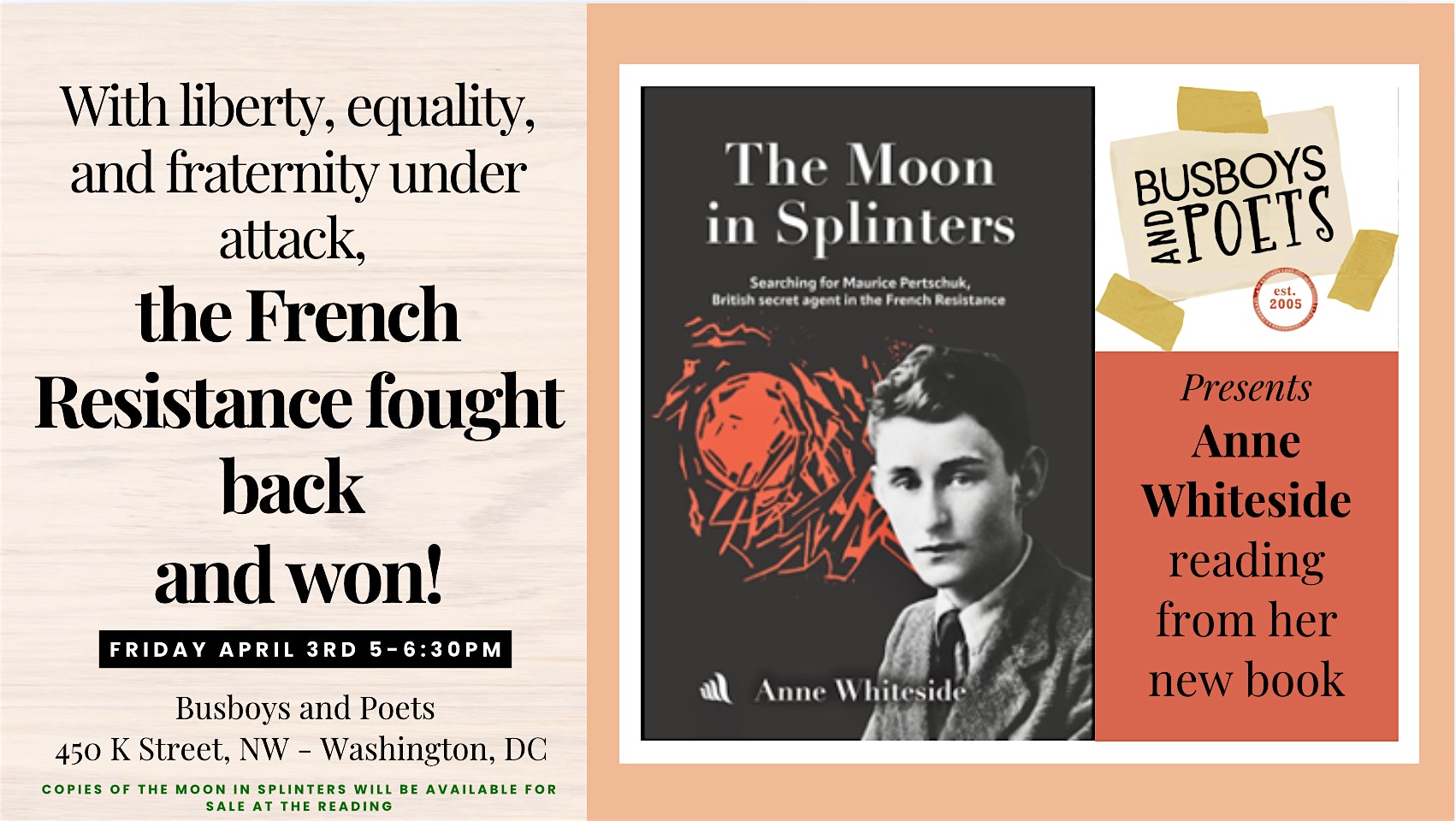
The Moon in Splinters Book Reading at Busboys and Poets – Washington, DC
At a time when Frances core values, liberté, egalité, fraternité, were under attack, the French Resistance fought back and won. We have much to learn from this movement
Register for the reading at Busboys & Poets April 3rd: RSVP HERE
Praise for Moon in Splinters
The stirring true story of a World War II French resister in The Moon in Splinters is exemplary in its immediacy the young hero was the authors uncle and in its authenticitythe author has spoken to every available eye-witness and has consulted every relevant document. Robert O. Paxton, Melon Professor Emeritus of Social Science, Columbia University
With a poets grace and a detectives tenacity, Anne Whiteside weaves a thrilling historical mystery into a deeply personal quest to understand a painful past. The result is a gem of a book timeless, urgent, and unforgettable. Sarah Ladipo Manyika, author of Like a Mule Bringing Ice Cream to the Sun and Between Starshine and Clay.
The Story
At age twenty, Maurice Pertschuk spent a year as an agent of Churchills secret army working with the French resistance. Landing on the Côte dAzur spring 1942, he led a clandestine network distributing anti-Vichy propaganda, gathering intelligence, then stocking arms for sabotage. As opposition to the occupiers grew, German military intelligence began infiltrating resistance circuits. A plot to blow up a gunpowder factory shipping chemicals to Germany turned into a trap: Pertschuk and many of his group were arrested, then deported to Germany. At Buchenwald, where he managed to conceal the fact that he was Jewish for 14 months, Pertschuk began composing lyrical poetry, written on scavenged bits of paper, a collection he called Leaves of Buchenwald. He was executed just 13 days before liberation, but his poetry survives, rescued by friends, published in 1946 and again in 2003.
Maurice Pertschuk was my maternal uncle. Like many survivors of war trauma, my family wouldnt talk about the subject, but his ghostly presence filled our imaginations.
Fast forward to 2010. After my mothers death, questions plague me: What made him take such risks? Was he reckless, as historians suggest? Who betrayed his group and how? How did he write poems in that hell? My search for answers will lead to three French women in their 90s, couriers in his circuit who described a large, powerful network; to his lover, who kept his portrait and poems by her bedside all her life; to families of other agents who share memoirs, photos and films. An inspiring story of a life led in secret- one of improvisation, fear, courage, deep friendship and romance- gradually takes shape, and delivers a surprise ending.
Tickets-RSVP Link
